
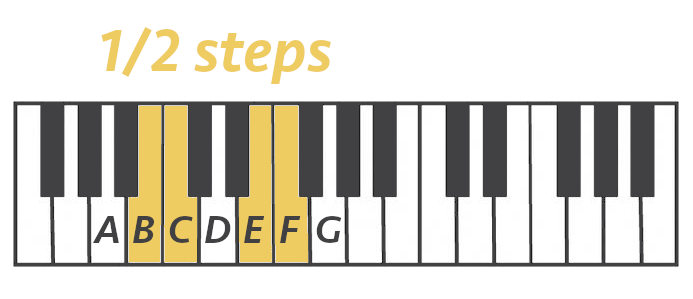
So you’re already familiar with the white keys on the piano and the C major scale? Great! Now it is time to learn about the black keys. But first, we need to talk about the smallest interval (distance between 2 notes) in western music: the half step.
Half steps and whole steps
If you look at the piano keyboard below you will see that there are no black keys in between B – C and E – F. We say that those notes are a half step apart (also called a semitone). There is however a black key between C – D, D – E, F – G, G – A and A – B. Those notes are two half steps apart, also called a whole step (or tone).
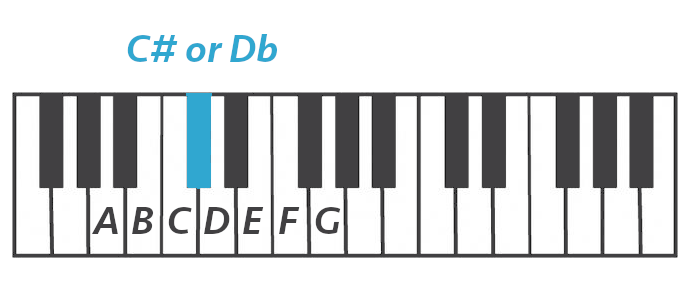
Naming the black keys
It is helpful to think of the black keys simply as “the keys in between the white keys”. We name the black keys using sharps (#) and flats (b). A “#” raises a note by a half step and a “b” lowers it by the same amount. For instance, the black key between C and D can be named C# (because it is a half step higher than C) or Db (because it is a half step lower than D).
The chromatic scale
If we play all the notes from C to C (including the black keys) we get a C chromatic scale. This scale contains all the notes we have available to us in western music. Unlike “normal” scales which consist of a mix of half steps and whole steps, the chromatic scale is made up of half steps only so it’s best to think of it as a palette of colours rather than a musical scale per se.

Musical examples
Listen to the first couple of bars of Bizet’s “Habanera”. That’s a descending chromatic scale: D C# C C C C B Bb A A G# G.
Another good example is “I’m a man” by The Spencer Davis Group. This is a one chord song (E7#9) with a few chromatically descending major chords in the chorus: G | Gb F
The intro to Nelly’s “Hot In Here” also consists of a few chromatic chords, this time over an E pedal. In other words: the LH plays the bass note E while the RH plays the following chords: G Gb | Gb F
Time to practice!
Chromatic scale exercise #1
Play the chromatic scale from C to C using one finger and say the names of the notes. Use the # names on the way up and the b names on the way down. If you are primarily a chordal player I recommend doing this with your thumb. Singing along to the piano will help you internalise the sound of the scale.
Chromatic scale exercise #2
Once you know the notes well you can start practicing the scale using the fingering below (RH):
Chromatic scale with power chords
Play the chromatic scale with power chords which are simply simplified chords consisting of only the root and the perfect 5th. This is a great starting point for learning major and minor triads in all keys: master this first and you can always add the middle note (the 3rd) in later 😉
Chromatic scale with major triads
Once you’re comfortable with the above you can move on to this exercise. Being able to play a major root position triad in all 12 keys is a great foundation for your chordal playing.