
In this lesson we will be covering the absolute basics you need in order to start playing pop piano chords today and have fun playing along to your favourite songs or accompanying yourself singing. Let’s get to it!
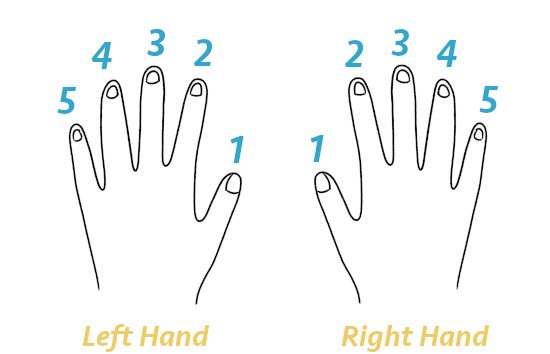
The Finger Numbers
Fingers are numbered starting with the thumb (finger 1) and ending with the pinky (finger 5).
The Keyboard Layout
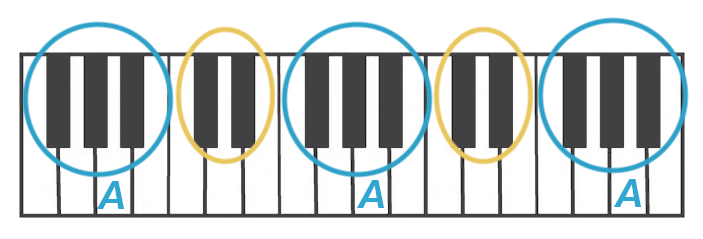
Look at the keyboard below and you’ll see a group of 3 black keys followed by a group of 2 black keys. This pattern repeats up and down the piano and we use it to orient ourselves. For instance, you’ll find the note A inside the group of 3 black keys.
Exercise #1: Play all the A’s you can find on the piano.
Up and Down
Lower notes are on the left side of the piano and higher notes are on the right side. This is often referred to as going up or down.

The Musical Alphabet
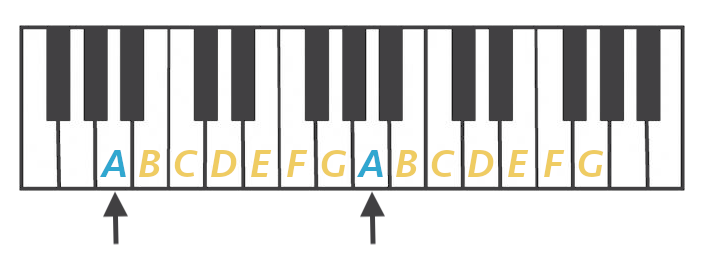
Just like any language, we need an alphabet. In music, we use the alphabet from A to G to name the notes. You will find A inside the group of 3 black keys. The next white key is B, followed by C, etc… and once you get to G it all repeats!
Exercise #2: Play the alphabet from A to G on the piano while saying the names of the notes out loud.
The C Major Scale
A scale is a group of notes that provides the tonal material (melody and chords) for a piece of music or song. The C major scale consists of all the white keys from C to C. We will be using this scale as our basis for learning the note names on the piano, our basic pop chords and developing our understanding of music theory.
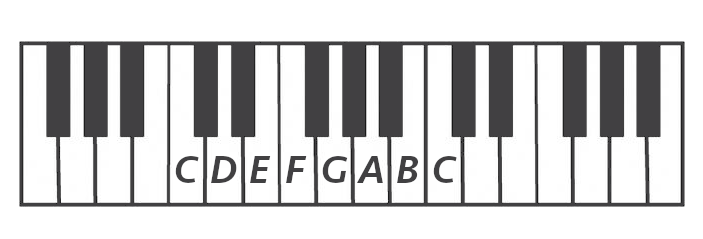
Exercise #3: Play the C major scale C to C with your right hand thumb (finger 1) while saying (or singing) the names of the notes out loud. Do this both ascending and descending so you can get familiar with the note names and the sound of the scale.
How To Build Basic Pop Chords
Basic pop chords contain 3 notes and are called triads. These can be major, minor or diminished but don’t get too hung up on that just yet!!! I will explain the difference later 🙂
We will be building our first pop chords by skipping notes inside the C major scale.
For a C chord (also called C major): we start on C, then skip the D and add the E, then skip the F and add the G. Play it with your right hand using finger 1 on C, finger 3 on E and finger 5 on G.
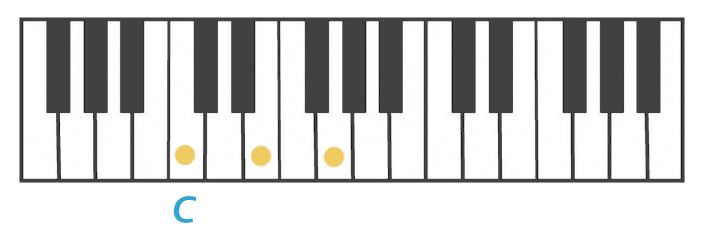
If we move this basic structure up a white key so that the thumb is now on D, we get a D minor chord (Dm), followed by an E minor (Em), an F major (F), a G major (G), an A minor (Am) and finally a B diminished (Bdim). Download the full chord diagrams here.
Don’t worry about the different chord names just now. Just focus on where your thumb is and on keeping the same structure/shape and fingering (1 3 5 in the right hand) for each of the chords.
Exercise #4: Play all the chords we’ve just learnt and say their names out loud. Do this both ascending: C, Dm, Em… and descending: C, Bdim, Am…
Playing Piano with Both Hands
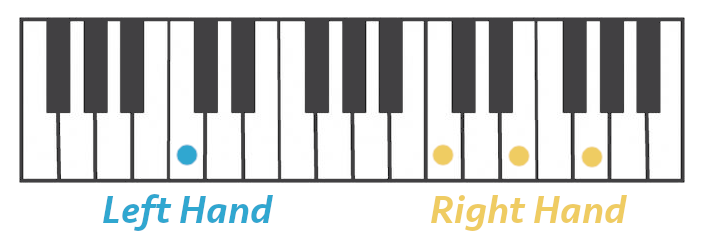
When playing piano with both hands, pianists usually double the lowest note of the chord (also called the root) in the left hand. So, for a C chord we simply add an extra C in the lower range of the piano:
Things to Remember:
- The term “C major” can both refer to a scale or a chord. All of the chords we’ve learnt today belong to the same scale of C Major.
- A chord can be major, minor, or diminished but we only specify if it is minor or diminished.
Now that we can play our basic pop chords, we are ready to learn some tunes! Check out my “Level 1” playlist for some song ideas 🙂