
Chords often move in predictable patterns. One of those is the circle of 4ths. Tunes such as “I Will Survive” by Gloria Gaynor, “Virtual Insanity” by Jamiroquai, “Sunday Morning” by Maroon 5, “From The Start” by Laufey and jazz classics like “Fly Me to the Moon” or “Autumn Leaves” all use the circle of 4ths in their chord progressions. In fact, we can say that the circle of 4ths is the “engine” behind a lot of chord progressions!
So what is the circle of 4ths exactly?
The circle of 4ths is simply a succession of perfect 4th intervals. If we start on B and count up a perfect 4th (4 letters in the alphabet) we get E.

From E we can go up a 4th to A, then D, G, C and F.
This is the “white portion” of the circle of 4ths: B E A D G C and F. Notice how the first 4 notes form a word: “bead”.
The “black portion” is the exact same thing just starting on Bb: Bb Eb Ab Db and Gb/F#. So spend as much time as you need on the “white portion” and that will make learning the “black portion” a lot easier! Check out the following video for more details:
Maroon 5 – Sunday Morning
The chord progression to this tune is ||: Dm7 G7 | CMaj7 :||. If you’re new to extended harmony or jazz chords you can simply play ||: Dm G | C :|| which will give you a less sophisticated sound but is essentially the same chords. Do you see how we go up a 4th from Dm to G and up a 4th again from G to C? That’s the circle of 4ths in action!
This is a very common chord progression in jazz music. We call it a ii V I (2 5 1) because in the key of C major, Dm is the 2nd chord, G is the 5th chord and C is the 1st chord.
Gloria Gaynor – I Will Survive
Here we have the following chord progression, also in the key of C or it’s relative minor Am.
||: Am7 | Dm7 | G7 | CMaj7 | FMaj7 | Bm7b5 | E7sus | E7 :||
See how this one follows the circle of 4ths too? There is one little exception though: in the circle of 4ths F would normally go to Bb but here, in order to stay diatonic (which is to say in the key of C/Am) the song moves to B natural instead. Apart from that it’s all perfect 4ths!
This diatonic version of the circle of 4ths is also used in other pop tunes like “Virtual Insanity” by Jamiroquai and countless jazz standards such as “Fly Me to the Moon”, “Autumn Leaves”, “All The Things You Are”, “Alice In Wonderland”…
Circle of 4ths drills
The circle of 4ths is also a great tool to practice chords with. Here’s a few drills I often use with my students:
- Play all major root position chords. Start on B then E, then A… Great for practicing major chords in all 12 keys.
- major – minor – major drill. Play B – Bm – B, then E – Em – E, etc…
- major – sus4 – major drill. Play B – Bsus4 – B, then E – Esus4 – E, etc… This chord movement is very common in songs and you can practice it in all 12 keys using the circle of 4ths!
You can also play all your 1st inversion major chords through the circle of 4ths or any chord, voicing, lick, idea in order to practice it in all 12 keys 🙂
What about the circle of 5ths?
The circle of 5ths is simply the circle of 4ths backwards.
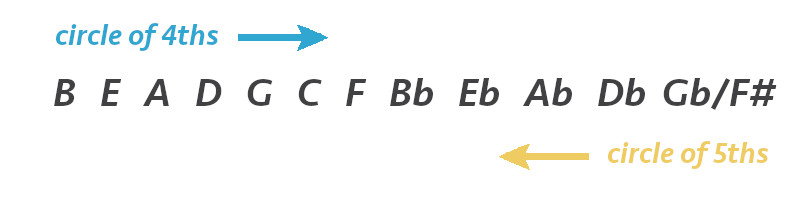
Although the circle of 5th is a more popular concept, the only tune I can think of that follows the circle of 5ths is “Hey Joe” by Jimi Hendrix which is why I teach the circle of 4ths to students and not the circle of 5ths. “Hey Joe” uses the following chord progression: ||: C G | D A | E | % :||
Other uses for the circle of 4ths
Since many songs use the circle of 4ths in their chord progressions, memorising this common pattern will make your life a lot easier when learning new tunes!
By memorising the circle of 4ths you can often predict where a song is going harmonically, for example a dominant 7th chord will usually resolve up a perfect 4th, like the G7 resolving to C in “Sunday Morning”.
The circle of 4ths can also tell you the main chords in a blues or country song as these types of songs mostly rely on the 1st, 4th and 5th chord of the key they are in. For instance a blues in C has F as it’s IV chord (after C in the circle of 4ths) and G as it’s V chord (before C in the circle of 4ths). So if you pick a key, the chord that’s after in the circle of 4ths will be the IV chord and the chord that’s before will be the V chord.